Microsoft killed Kelihos botnet, (Tue, Sep 27th)
Great news for Internet security. Microsoft has effectively killed off the Kelihos botnet which has ...(more)...
5:57 AM (42 minutes ago)
Magic Mushroom Drug Has an 'Anti-Aging Effect' on Personality
 Psilocybin, the drug in “magic mushrooms,” helps many people become more open, creative, and curious after they take a single high dose, a new study shows.
Sep 27, 2011 (4 days ago)
iPhone event 10/4, iPhone 5 on sale mid-October, iPad Facebook app to surface at iPhone event
Apple has confirmed that there will be an iPhone event on October 4. The event is called the "Let's Talk iPhone" event ensuring there will be some new announcements about the long rumored iPhone 5.

A source has tipped that the iPhone 5 will go on sale on October 14. The phone will launch on that day in the US, UK, Germany, France, and Japan says the source.
The iPad Facebook app may be making a debut at the iPhone even next month. It would be no surprise to see talk of some other things at the iPhone event we have all been waiting for.

A source has tipped that the iPhone 5 will go on sale on October 14. The phone will launch on that day in the US, UK, Germany, France, and Japan says the source.
The iPad Facebook app may be making a debut at the iPhone even next month. It would be no surprise to see talk of some other things at the iPhone event we have all been waiting for.
Sep 30, 2011 (14 hours ago)
Scottish pub to replace Harlow’s on Ballard Ave.
The owners of Bastille have reportedly purchased the building Harlow’s was in and plans to open a Scottish pub.

According to SeattleMet.com, Deming Maclise and James Weimann will soon open Macleod’s Scottish Pub (5200 Ballard Ave).
“The new bar is named for Allen Macleod, a friend of Weimann and Maclise’s who painted both of their restaurants,” writes Jessica Voelker in the article. “The rep [of Weimann and Maclisse] says Allen is from Edinburgh, Scotland where he was a bartender. He’ll be the owner and operator; Weimann and Maclise will take charge of the concept and design but consider themselves silent partners.”
According to SeattleMet.com, Deming Maclise and James Weimann will soon open Macleod’s Scottish Pub (5200 Ballard Ave).
“The new bar is named for Allen Macleod, a friend of Weimann and Maclise’s who painted both of their restaurants,” writes Jessica Voelker in the article. “The rep [of Weimann and Maclisse] says Allen is from Edinburgh, Scotland where he was a bartender. He’ll be the owner and operator; Weimann and Maclise will take charge of the concept and design but consider themselves silent partners.”
Sep 27, 2011 (4 days ago)
Important Communication to All Aid Bloggers Related to the Urgent Need for Better Coordination in the Sector
Dear Stakeholders,
It has come to my attention that there really are too many aid blogs out there, aren't there? That's obviously not good for the aid-blog sector, because as you surely agree there is too much "duplication of effort" and lack of "sharing of lessons learned" and "best practices" and "leverage of knowledge" among the different stakeholders.
Obviously what we need is more coordination.
As a self-appointed leader of the sector HRI is hereby suggesting we start focusing on coordination of all aid-blogging activities across the aid-blogging sector. HRI has already helpfully received an award from The Donor to support with this coordination effort (why would it have been competed? better to "sole-source" these things to the coordination experts) and as we speak a reasonably paid consultant is on the way here and should be shortly in touch with some matrix or other.
What you all need to do now is nominate a focal point (for now - you will need more focal points shortly as we expect coordination activities to start branching out across sub-themes and sub-committees).
The plan is we'll start by having weekly meetings at the heads-of-blogging-agency level and there will be weekly focal point meetings in the coordination task force. Various sub-themes will be then identified (aid, development, M&E, snark, etc.) and Lead Blogs will be allocated to each of these themes.
Sub-committees should be in place ("scaled-up") by mid-October and leading agencies should start reporting regularly to the Task Force and Coordination Group regularly. The Coordination Matrix will be filled in by individual blogs and then reviewed by our consultant. Tool-kits shoudl be distributed in January 2012.
In the following phase, a Communication Coordination Sub-Group will be set up that will be tasked with "clearing" any new post in the aid-blogging sector, to ensure coordinated messages and to avoid conflicting communication. We are also expected to agree on geographical priorities and different countries/ continents will be allocated to different blogs to ensure uniform coverage and "bridging of gaps".
Finally, sometime next year, HRI's M&E consultant will be in touch with a strategy that will prove beyond any doubt the added value of a truly coordinated strategy.
Thanks folks for your cooperation - and I have no doubt that together we'll successfully coordinate the shit out of the aid-blogging industry!
PS: costs will be shared across the sector, please ensure you allocate sufficient resources in your 2012 work-plans for this important activity.
It has come to my attention that there really are too many aid blogs out there, aren't there? That's obviously not good for the aid-blog sector, because as you surely agree there is too much "duplication of effort" and lack of "sharing of lessons learned" and "best practices" and "leverage of knowledge" among the different stakeholders.
Obviously what we need is more coordination.
As a self-appointed leader of the sector HRI is hereby suggesting we start focusing on coordination of all aid-blogging activities across the aid-blogging sector. HRI has already helpfully received an award from The Donor to support with this coordination effort (why would it have been competed? better to "sole-source" these things to the coordination experts) and as we speak a reasonably paid consultant is on the way here and should be shortly in touch with some matrix or other.
What you all need to do now is nominate a focal point (for now - you will need more focal points shortly as we expect coordination activities to start branching out across sub-themes and sub-committees).
The plan is we'll start by having weekly meetings at the heads-of-blogging-agency level and there will be weekly focal point meetings in the coordination task force. Various sub-themes will be then identified (aid, development, M&E, snark, etc.) and Lead Blogs will be allocated to each of these themes.
Sub-committees should be in place ("scaled-up") by mid-October and leading agencies should start reporting regularly to the Task Force and Coordination Group regularly. The Coordination Matrix will be filled in by individual blogs and then reviewed by our consultant. Tool-kits shoudl be distributed in January 2012.
In the following phase, a Communication Coordination Sub-Group will be set up that will be tasked with "clearing" any new post in the aid-blogging sector, to ensure coordinated messages and to avoid conflicting communication. We are also expected to agree on geographical priorities and different countries/ continents will be allocated to different blogs to ensure uniform coverage and "bridging of gaps".
Finally, sometime next year, HRI's M&E consultant will be in touch with a strategy that will prove beyond any doubt the added value of a truly coordinated strategy.
Thanks folks for your cooperation - and I have no doubt that together we'll successfully coordinate the shit out of the aid-blogging industry!
PS: costs will be shared across the sector, please ensure you allocate sufficient resources in your 2012 work-plans for this important activity.
Sep 14, 2011 1:08 PM
It's Official: J.J. Abrams to Direct Star Trek 2
Vulture reports that J.J. Abrams has officially committed to direct Star Trek 2 for Paramount Pictures. Pre-production is currently underway and the script is expected to be done by month's end. Abrams will start shooting the anticipated film this winter. The Star Trek sequel was originally scheduled to be released on June 29, 2012, but Paramount put G.I. Joe 2 in that spot instead when it looked like Abrams wouldn't be able to make the date. While Abrams himself couldn't start working on Star Trek 2 until he was done with Super 8 , the article says that part of the delay has also been Alex Kurtzman, who has been working on the script with Roberto Orci. Kurtzman had been busy working on finishing directing Welcome to People . A new release date for the film has...
Sep 13, 2011 10:08 PM
How to see people, not just our reactions to them
 When we encounter someone, usually the mind automatically slots the person into a category: man, woman, your friend Tom, the kid next door, etc. Watch this happen in your own mind as you meet or talk with a co-worker, salesclerk, or family member.
In effect, the mind summarizes and simplifies tons of details into a single thing – a human thing to be sure, but one with an umbrella label that makes it easy to know how to act. For example: “Oh, that’s my boss (or mother-in-law, or boyfriend, or traffic cop, or waiter) . . . and now I know what to do. Good.”
This labeling process is fast, efficient, and gets to the essentials. As our ancestors evolved, rapid sorting of friend or foe was very useful. For example, if you’re a mouse, as soon as you smell something in the “cat” category, that’s all you need to know: freeze or run like crazy!
On the other hand, categorizing has lots of problems. It fixes attention on surface features of the person’s body, such as age, gender, attractiveness, or role. It leads to objectifying others (e.g., “pretty woman,” “authority figure”) rather than respecting their humanity. It tricks us into thinking that a person comprised of changing complexities is a static unified entity. It’s easier to feel threatened by someone you’ve labeled as this or that. And categorizing is the start of the slippery slope toward “us” and “them,” prejudice, and discrimination.
Flip it around, too: what’s it like for you when you can tell that another person has slotted you into some category? In effect, they’ve thingified you, turned you into a kind of “it” to be managed or used or dismissed, and lost sight of you as a “thou.” What’s this feel like? Personally, I don’t like it much. Of course, it’s a two-way street: if we don’t like it when it’s done to us, that’s a good reason not to do it to others.
The practice I’m about to describe can get abstract or intellectual, so try to bring it down to earth and close to your experience.
When you encounter or talk with someone, instead of reacting to what their body looks like or is doing or what category it falls into:
- Be aware of the many things they are, such as: son, brother, father, uncle, schoolteacher, agnostic, retired, American, fisherman, politically conservative, cancer survivor, friendly, smart, donor to the YMCA, reader of detective novels, etc. etc.
- Recognize some of the many thoughts, feelings, and reactions swirling around in the mind of the other person. Knowing the complexity of your own mind, try to imagine some of the many bubbling-up contents in their stream of consciousness.
- Being aware of your own changes – alert one moment and sleepy another, nervous now and calm later – see changes happening in the other person.
- Feeling how things land on you, tune into the sense of things landing on the other person. There is an experiencing of things over there – pleasure and pain, ease and stress, joy and sorrow – just like there is in you. This inherent subjectivity to experience, this quality of be-ing, underlies and transcends any particular attribute, identity, or role a person might have.
- Knowing that there is more to you than any label could ever encompass, and that there is a mystery at the heart of you – perhaps a sacred one at that – offer the other person the gift of knowing this about them as well.
The more significant the relationship, the more it helps to see beings, not bodies.
Related posts:
- Meditation makes people more rational decision-makers Elizabeth Weise: Meditation, the ancient practice of mindfulness employed by...
- Guided Meditations for Busy People Bodhipaksa has recorded a CD (also available as a download)...
- Tips for busy people for a daily meditation practice Are you one of those people who would like to...
Sep 15, 2011 1:06 PM
The Phillies And Mural Arts Team Up To Design A New Eight-Story Mural To Be Installed Along The Schuylkill River In 2012
 The 3,750-square foot image is set to be completed next summer, and will feature more than 30 prominent players from the team's record-long history — and, of course, the Phillie Phanatic. (Photo courtesy Phillies, Copyright Mural Arts Program)
Towering almost eight stories high, The Phillies Mural will be located in Center City on the face of a building at 24th & Walnut Streets. The building is located prominently along the Schuylkill Banks at the base of the Walnut Street Bridge, facing the Schuylkill River and I-76 Schuylkill Expressway for thousands of daily passersby to see.
The 3,750-square foot image was designed by David McShane, the award-winning artist for the Mural Arts Program, and a self-proclaimed lifetime Phils fan. McShane’s impressive artistic history includes the creation of more than 75 murals throughout Philadelphia, and includes baseball-themed murals “Tribute to Jackie Robinson” in North Philly, and “Philadelphia Stars: A Tribute to Negro League Baseball” in West Philly.
The mural (see above; also see a close-up view below) will feature more than 30 prominent players depicting historical moments from the team’s record-long history, including the 1980 and 2008 World Series championships.
Plus, The Phillies Mural includes space for one more player, to be chosen by fans via online voting on phillies.com. Details on the final player vote will be forthcoming in the upcoming weeks.
Said Mayor Michael A. Nutter. “There is nothing we enjoy more in Philadelphia than our sports teams, and this mural will share our love for the Phillies with everyone who visits.”
And Jane Golden, Executive Director of the Mural Arts Program, said, “With over 3,500 murals to date that the Mural Arts Program has created, there are few that will stir the passion of such a wide variety of Philadelphians. Hopefully this project will turn sports fans into art fans as David McShane brings the history of Philadelphia’s baseball to life in Center City.”
Our passion is certainly stirred. The mural is set to be completed in the summer of 2012, and will include include numerous community paint days, so you can take part in its creation.
We can’t wait to see this project come to life! See below for a full list of images to be included in the mural, as well as a close-up on the design.
The Phillies Mural Project [MLB.com]
 The design features more than 30 prominent players depicting historical moments from the team’s record-long history; full list below. (Photo courtesy Phillies, Copyright Mural Arts Program)
Sep 13, 2011 9:48 AM
We Are So Screwed, Tea Party Debate Edition
Applause lines:

- The uninsured should be left to die.
- Said uninsured parents should have daughters who die unnecessarily of cervical cancer.
- A Fed Chairman who tries to fulfill his mandate by reducing unemployment is guilty of treason.
- Muslims are not collectively responsible for 9/11.
- The children of illegal immigrants should not be denied the chance to go to college.
- We should not pass an extraordinarily regressive tax cut.
Sep 15, 2011 3:12 PM
Willow, Lost Cat From Colorado, Resurfaces in Manhattan
The calico cat who disappeared from her Rocky Mountain home was discovered on East 20th Street, but her 1,800-mile journey remains a mystery.

Sep 13, 2011 9:11 AM
THREE PANELS OPEN: Esquivel Godlewski Cody Barajas

Script: Eric M. Esquivel (www.Facebook.com/ericMesquivelFanPage)
Art: Scott Godlewski (http://scottgodlewski.com/)
Colors: Ryan Cody (http://super75comics.wordpress.com/)
Letters: Henry Barajas (http://henrybarajas.wordpress.com/)
Sep 15, 2011 8:33 PM
First Professor Layton vs Ace Attorney screenshots. The new...


First Professor Layton vs Ace Attorney screenshots. The new characters accompanying the professor, Phoenix, Luke, and Maya, are Mahoney, the blond girl accused of being a witch; and Jeeken, the ginger prosecutor/knight.
This Level-5/Capcom 3DS collab, which has only been announced for Japan so far, introduces a “Mob Judgment” system in which ”Phoenix goes up against a crowd of witnesses” and “witnesses may talk amongst themselves during a cross-examination”.
Preorder: Professor Layton & the Last Specter, a 3DS
Find: Nintendo DS/3DS release dates, discounts, & more
See also: More Tokyo Game Show 2011 news/media
[Via Famitsu, Andriasang, Court-Records]


Sep 20, 2011 6:42 PM
SSL/TLS Vulnerability Details to be Released Friday, (Tue, Sep 20th)
I'm getting a lot of emails asking about articles that ultimately reference this upcoming talk: &quo ...(more)...
Sep 15, 2011 2:59 AM
The evolution of overconfidence
The evolution of overconfidence
Nature 477, 7364 (2011). doi:10.1038/nature10384
Authors: Dominic D. P. Johnson & James H. Fowler
Confidence is an essential ingredient of success in a wide range of domains ranging from job performance and mental health to sports, business and combat. Some authors have suggested that not just confidence but overconfidence—believing you are better than you are in reality—is advantageous because it serves to increase ambition, morale, resolve, persistence or the credibility of bluffing, generating a self-fulfilling prophecy in which exaggerated confidence actually increases the probability of success. However, overconfidence also leads to faulty assessments, unrealistic expectations and hazardous decisions, so it remains a puzzle how such a false belief could evolve or remain stable in a population of competing strategies that include accurate, unbiased beliefs. Here we present an evolutionary model showing that, counterintuitively, overconfidence maximizes individual fitness and populations tend to become overconfident, as long as benefits from contested resources are sufficiently large compared with the cost of competition. In contrast, unbiased strategies are only stable under limited conditions. The fact that overconfident populations are evolutionarily stable in a wide range of environments may help to explain why overconfidence remains prevalent today, even if it contributes to hubris, market bubbles, financial collapses, policy failures, disasters and costly wars.

Nature 477, 7364 (2011). doi:10.1038/nature10384
Authors: Dominic D. P. Johnson & James H. Fowler
Confidence is an essential ingredient of success in a wide range of domains ranging from job performance and mental health to sports, business and combat. Some authors have suggested that not just confidence but overconfidence—believing you are better than you are in reality—is advantageous because it serves to increase ambition, morale, resolve, persistence or the credibility of bluffing, generating a self-fulfilling prophecy in which exaggerated confidence actually increases the probability of success. However, overconfidence also leads to faulty assessments, unrealistic expectations and hazardous decisions, so it remains a puzzle how such a false belief could evolve or remain stable in a population of competing strategies that include accurate, unbiased beliefs. Here we present an evolutionary model showing that, counterintuitively, overconfidence maximizes individual fitness and populations tend to become overconfident, as long as benefits from contested resources are sufficiently large compared with the cost of competition. In contrast, unbiased strategies are only stable under limited conditions. The fact that overconfident populations are evolutionarily stable in a wide range of environments may help to explain why overconfidence remains prevalent today, even if it contributes to hubris, market bubbles, financial collapses, policy failures, disasters and costly wars.
Sep 14, 2011 10:54 AM
kleptocracy
A government by the corrupt in which rulers use their official positions for personal gain.
Sep 13, 2011 9:52 AM
If you don’t have pet projects, I don’t think I want you
I am busy hiring people now, and it got me thinking a lot about the sort of things that I want from my developers. In particular, I was inundated in CVs, and I used the following standard reply to help me narrow things down.
After getting the projects and looking them over a bit, I replied that I don’t think this would be the appropriate position for this respondent. I got the following reply:
Let me try to preempt the nitpickers. Not having pet projects doesn’t mean that you are a bad developer, nor vice versa.
But I don’t really care about experience, and assuming that you already know the syntax and has some basic knowledge in the framework, we can use you. But the one thing that I learned you can’t give people is the passion for the field. And that is critical. Not only because it means that they are either already good or going to be good (it is pretty hard to be passionate about something that you sucks at), but because it means that they care.
And if they care, it means two very important things:

Thank you for your CV. Do you have any projects that you wrote that I can review? Have you done any OSS work that I can look at?The replies are fairly interesting. In particular, I had a somewhat unpleasant exchange with one respondent. In reply for my question, the reply was:
My employer doesn’t allow any sharing of code. I can find some old projects that I did a while ago and send them to you, I guess.Obviously, I don’t want to read any code that belong to someone without that someone’s explicit authorization. Someone sending me their current company code is about as bad manner as someone setting up an invite for a job interview on their work calendar (the later actually happened today).
After getting the projects and looking them over a bit, I replied that I don’t think this would be the appropriate position for this respondent. I got the following reply:
Wait a minute…My response to that was:
Can I know why? I took the trouble to send you stuff that I have done, maybe not the highest quality and caliber, but what I could send right now. You didn’t even interview me.
How exactly did you reach the unequivocal conclusion that I am not a good fit for this job?
Put simply, we are looking for a .NET developer and one of the most important things that we look for is passion. In general, we have found that people that care and are interested in what they are doing tend to do other stuff rather than just their work assignments.There is more, but it gets to the details and not really relevant for this discussion.
In other words, they have their own pet projects, it can be a personal site, a project for a friend, or just some code written to get familiar with some technology.
When you tell me that your only projects outside of work are 5+ years old, that is a bad indication for us.
Let me try to preempt the nitpickers. Not having pet projects doesn’t mean that you are a bad developer, nor vice versa.
But I don’t really care about experience, and assuming that you already know the syntax and has some basic knowledge in the framework, we can use you. But the one thing that I learned you can’t give people is the passion for the field. And that is critical. Not only because it means that they are either already good or going to be good (it is pretty hard to be passionate about something that you sucks at), but because it means that they care.
And if they care, it means two very important things:
- The culture of the company is about caring for doing the appropriate thing.
- The end result is going to be as awesome as we can get.
Sep 13, 2011 7:23 AM
China Not Only Has Diablo V... [Diablo]


Sep 12, 2011 10:43 AM
Hans-Peter Feldmann at the Guggenheim

Venue: Guggenheim, New York
Date: May 20 – November 2, 2011
Click here to view slideshow


Full gallery of images, press release and link available after the jump.
Images:


 Images courtesy of the Guggenheim, New York
Press Release:
Hans-Peter Feldmann has spent over four decades conducting a profound investigation into the influence of the visual environment on our subjective reality. Composing images and objects into serial archives, uncanny combinations, and other illuminating new contexts, his work unearths the latent associations and sentiments contained within the landscape of daily life. As the winner of the 2010 HUGO BOSS PRIZE, a biennial award recognizing significant achievement in contemporary art, Feldmann received an honorarium of $100,000. For his solo exhibition at the Guggenheim, he has chosen to pin this exact amount to the gallery walls in a grid of overlapping one-dollar bills.
The installation, which uses money that has previously been in circulation, extends the artist’s lifelong obsession with collecting familiar material into simple groupings that reveal a nuanced play of similarity and difference. Throughout his practice, Feldmann has frequently divided an apparent whole into separate components; he has photographed every item in a woman’s wardrobe (All the clothes of a woman, 1973), presented individual images of the strawberries that make up a pound of fruit (One Pound Strawberries, 2005), and created a sequence of 100 portraits showing individuals of every age in a collective lifespan of a century (100 Years, 2001).
Feldmann also has a history of resisting the art world’s commercial structures, issuing his work in unsigned, unlimited editions and retiring from art making altogether for nearly a decade in the 1980s, at which point he gave away or destroyed the works remaining in his possession. Bank notes, like artworks, are objects that have no inherent worth beyond what society agrees to invest them with, and in using them as his medium, Feldmann raises questions about notions of value in art. But his primary interest in the serial display of currency lies less in its status as a symbol of capitalist excess than in its ubiquity as a mass-produced image and a material with which we come into contact every day. At its core, this formal experiment presents an opportunity to experience an abstract concept—a numerical figure and the economic possibilities it entails—as a visual object and an immersive physical environment.
—Katherine Brinson, Assistant Curator
Link: Hans-Peter Feldmann at the Guggenheim
Sep 12, 2011 7:48 AM
Automate and Sync Your Web With ‘If This, Then That’
 A few of the many tasks Ifttt can automate for you
At its most basic level Ifttt is what its founders call “digital duct tape… allowing you to connect any two services together.” On a perfect web Ifttt wouldn’t be necessary, every service would talk to every other service and everything would just work. Obviously that web doesn’t exist, so there’s Ifttt.
The best way to understand how Ifttt works is by example. Let’s say you want to share links with other people on the web. You might store links in Delicious or Pinboard for yourself and then post them to services like Twitter or Facebook for your friends to see. That’s all well and good, but what if you could automate the process? That’s where Ifttt comes in.
The usefulness is in the name — if this, then that. Sticking with the link example, we might create a task that works like this: IF a new link is posted to Delicious, THEN grab the link and post it to Twitter and Facebook.
The basic workflow is to choose a service from the list (which include popular web services like Instagram, Tumblr and Wordpress, or more general tasks like phone calls, SMS or time-based actions). Once you have the “this,” the next step is choosing a trigger. Triggers vary according to the “this” you’ve selected. For example the Delicious triggers include things like “any new public bookmark” or “new bookmark tagged,” while the time option has triggers like “Every day at” or “Every year on.” Once you have your trigger set, you add the “that” portion of Ifttt’s name, which consists of a list of services like the “this” portion.
Maybe links aren’t a particularly interesting use case these days, here’s a better one for the kids: every time you post an image to your Instagram account, have Ifttt.com grab a copy and sync it over to your dropbox folder for instant backups. Or send starred items in Google Reader to Read it Later or Instapaper. Or send yourself an email every time an Orange Bass Cabinet pops up on Craigslist. Or create daily reminders with the time triggers. Or trigger a fake phone call to escape awkward situations.
Because the possibilities of Ifttt can be overwhelming, along with the public launch, Ifttt introduced a new feature called recipes, which are simply a way of sharing your tasks (not the data in the tasks, just the tasks). The site has only been public for a few days and already there are hundreds of recipes.
If you’d like to automate your web, head on over to Ifttt.com and sign up for a free account.
Sep 12, 2011 12:43 PM
Cliffoney Birds of Furious Thunder

This one is for my friend & driver on the day in Co. Sligo, Mr @da_kar [Darren Carr]. It's amazing what shots you can get from the window of a car.
Sep 16, 2011 1:58 PM
Artest's name now officially Metta World Peace
 A Los Angeles court commissioner has approved Ron Artest's petition to change his name to Metta World Peace.
Sep 14, 2011 10:13 PM
Apple Suppresses Dissent
Paolo Pedercini's game Phone Story, which deals with the issues of forced and sweatshop labor in the production of mobile phones, has been banned by Apple's app store on the spurious grounds that it "depicts violence toward children." Actually, it depicts the iniquitous effects of Apple's outsourcing practices and lack of corporate responsibility, and indeed, by banning the game, Apple merely makes that lack of responsibility clear.
The case for bailing out of the Apple ecosystem and adopting open platforms could not be starker. Junk your iPhone.
Pedercini is the brilliant creator of such landmark "games for change" as The McDonald's Game and Oiligarchy, and the equally brilliant art game, every day the same dream.
The Android version is still available; proceeds go to support Students and Scholars Against Corporate Misbehavior.
The case for bailing out of the Apple ecosystem and adopting open platforms could not be starker. Junk your iPhone.
Pedercini is the brilliant creator of such landmark "games for change" as The McDonald's Game and Oiligarchy, and the equally brilliant art game, every day the same dream.
The Android version is still available; proceeds go to support Students and Scholars Against Corporate Misbehavior.
Sep 16, 2011 6:49 AM
Portal is free! Portal is free! (for PC and Mac)
If you haven't had the pleasure of playing this ingenious, award-winning, beloved first-person puzzle-adventure-mystery, now's your chance to do so for $0.

Sep 14, 2011 5:32 AM
Malware burrows deep into computer BIOS to escape AV
Mebromi rootkit also targets master boot record
Researchers have discovered one of the first pieces of malware ever used in the wild that modifies the software on the motherboard of infected computers to ensure the infection can't be easily eradicated.…Sep 12, 2011 9:54 AM
Flight 93
Jonathan Last makes an excellent point:
Despite the national memorial now emerging in Shanksville, I don’t think America has fully begun to appreciate where Flight 93 fits into the pantheon of great moments in American history. I’d argue that–for a host of reasons–it belongs somewhere in the same neighborhood as Little Round Top and Revere’s ride. It’s fitting that we mourn the World Trade Center and Pentagon dead on 9/11, but properly understood our commemorations every year should start there and build toward reverence and appreciation for the men and women of Flight 93. That field in Pennsylvania, not the hole in Manhattan, should be our enduring symbol of the day.
A bunch of yuppie strangers self-organized within minutes and not only saved the Capitol or the White House, but appear, a decade later, to have historically eliminated the strategic threat posed by airline hijacking for kamikaze purposes. For about two hours, the bad guys seemed to have invented an unstoppable new weapon, with who knows what dire long term consequences. But then it proved they were stoppable by unarmed frequent flyers. And, probably consequently, there haven’t been any kamikaze hijackings in America since Flight 93. And two would-be suicide bombers on airplanes have been disarmed by passengers in the years since.
As an old yuppie marketing researcher, I take pride in knowing that one of the heroes who rushed the cabin on Flight 93 was a marketing researcher whose boss on 9/11 had been my boss back in 1982.

Sep 13, 2011 9:17 PM
Google Flights Search Is a Powerful, Intuitive, Lightning-Fast Tool for Finding Cheap Tickets

Sep 11, 2011 3:59 AM
Felted Berets For Your Cat


I was just thinking my cat's wardrobe could use a jolt of style... Maybe a felted beret from ToScarboroughFair on Etsy is in order? [via The Dainty Squid]
Sep 13, 2011 10:39 AM
Sex, Death, and the Appalachian Trail
 I’ve always had a fondness for Toxoplasma, to the point of featuring it prominently in one of my novels. It’s a protozoan after my metaphorical heart and my literal brain (specifically the part that synthesizes dopamine), and many of yours as well; in past installments (scroll down to May 6 on the right-hand side) I’ve eagerly reported on its potential role in the national characteristics of certain European cultures, on its tendency to increase scruffiness in males and sluttiness in females, even on its association with a marine mammal of my acquaintance from back in grad school — but most importantly, on its definitive host, the domestic LOLcat.
It’s long been known that Toxo trades up: slumming halfway through life in the brains of rats, it needs to get inside a cat to complete its life cycle. The mechanism by which it does this is also well-known in broad and correlative strokes; somehow it takes a rat’s normal aversive response to the smell of cat pee and flips it one-eighty, turns the smell of urine into an attractant. Rat detects a predator that would normally make it head for the hills, seeks out said predator, chomp. Mission accomplished
 .
.What no one had figured out before now was how Toxoplasma actually did that. Now, thanks to the neurotrinity of House, Vyas, and Sapolsky (no, not that House; yes, that Sapolsky), we know1.
Sex. Toxoplasma makes its host horny at the scent of feline showers. It gets right down into the amygdala and rewires pathways of sexual attraction so they respond to flight stimuli instead. It’s almost a pity the cat generally eats the infectee before the rat has the chance to ask her out; one has to wonder what kind of kinkiness might ensue if not for the whole buzz-kill of getting eaten alive. (With luck, that will be the subject of some future study.)
The thing to note here is that the fear response is not erased; in fact, when infected rats were exposed to the scent of cat urine their neural activity — normalized against uninfected controls — spiked in both the reproductive and aversive circuits. So it’s not as though these guys were fearless. For all we know they were still scared shitless. It’s just that whatever fear they experienced was overwhelmed by sheer hot interspecies horniness.

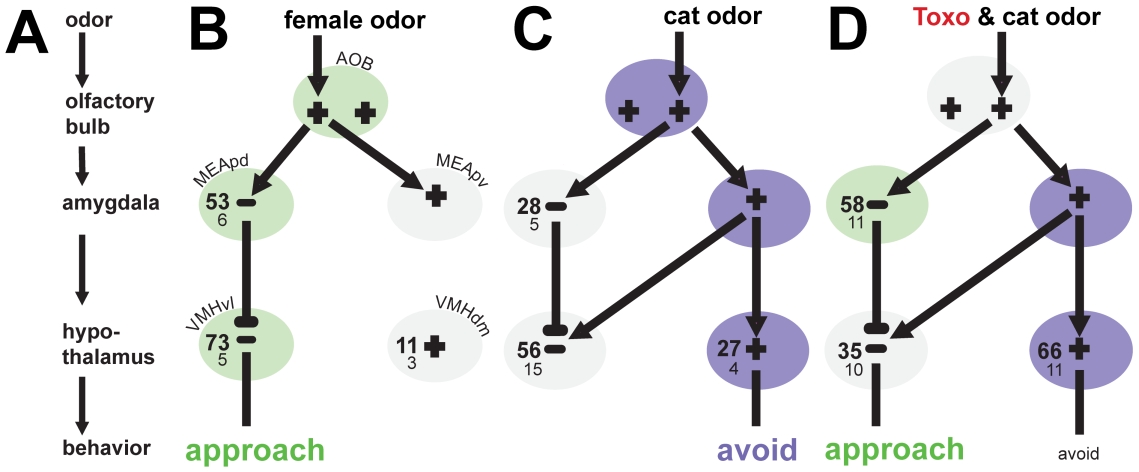 PLoS ONE 6(8): e23277. doi:10.1371/journal.pone.0023277
I can’t believe anyone could be that stupid. There must have been an edge of fear to every dalliance, some inner voice warning of sudden death around the corner. Maybe that even added to the thrill. But the fact is, fear is only one driver; and here in Darwin’s universe, the brazen frequently leave more genes to the next generation than the overly cautious. A long life gets you nowhere if it is chaste; a short life’s no disadvantage if you leave a thousand sprogs behind.
Sex trumps survival. We see it in rats. We see it in politicians. That makes it ubiquitous at least throughout the Rodentia. Toxoplasma didn’t invent that inequality, but it sure knows how to make the most of it.
If I ever decide to run for office, remind me to get my amygdala checked for cysts.
—————————————————
1We also now know that you culture Toxoplasma on fibroblast monolayers grown from human foreskins, although I didn’t really need to.
Sep 15, 2011 9:19 AM
Drive / ***1/2 (R)
"Drive" (R, 100 minutes). Ryan Gosling in an extraordinary performance as a man who drives for a living--as a stunt man in movies, and as a getaway driver for hire. He seems to have no personal life, betrays no emotions, lives simply to function. When he begins to feel fondness for the little boy of his neighbor (Carey Mulligan), he grows involved in a $1 million heist that's a test of his conscience and loyalties. It looks like a routine action picture, but believe me, it isn't. Even the car chases look like the real thing. We care about them. We're not just looking at technology. Three and a half stars.
Sep 11, 2011 9:10 PM
Fat Tabby Cats Inserted Into World Renowned Masterpieces [Art]


Sep 10, 2011 8:50 PM
Control all your PCs from one mouse and keyboard with Microsoft’s new app

Microsoft have released a great little app for users us with multiple PCs. The addin comes from a Garage project at Microsoft which is a program designed to encourage incubations of ideas and projects.
With the application it treats all your Windows PCs as if they were one single desktop, so if you have two machines side by site (as I do at work) you can use the mouse as though they were one PC including dragging files between them. It’s a great idea and if you have a dedicated Media Center machine connected to your TV as well a laptop it would be a great way of controlling it from one place.
Steve Clayton’s Technet blog has the details:
Mouse Without Borders is a project I’ve been familiar with for the last 6 months or so and it’s a wonderfully useful tool. In a nutshell, it allows you to reach across your PC’s as if they were part of one single desktop. I have two PC’s on my desk at work connected to 3 LCD screens and using Mouse Without Borders I can move my mouse between the 3 screens, even though one of them is attached to a different PC from the other two. What’s more, I can move files between the 2 computers simply by dragging them from one desktop to another. In fact you can control up to four computers from a single mouse and keyboard with no extra hardware needed – it’s all software magic, developed by Truong Do who by day is a developed for Microsoft Dynamics. The software is easy to setup and in addition to enabling drag and drop of files, you can lock or log in to all PCs from one PC, and as a whimsical bonus is it allows you to customize your Windows logo screen with the daily image from Bing or a local collection of picturesI regularly use it to have one PC dedicated to social media streams while I work away on my other PC connected to two screens.
Download Now [1.1mb]


Sep 14, 2011 1:50 AM
Laughter Produces Endorphins, Study Finds
The simple muscular exertions involved in producing laughter cause an increase in endorphins, the brain chemicals known for their feel-good effect.

Sep 14, 2011 9:14 AM
New Biography Claims Sarah Palin Had A One-Night Stand With Glen Rice In 1987 [Sarah Palin]


Sep 11, 2011 10:52 AM
Jimmy Carter: 'We never dropped a bomb. We never fired a bullet. We never went to war'

Where does Jimmy Carter live? Well, close your eyes and imagine the kind of house an ex-president of the United States might live in. The sort of residence befitting the former leader of the most powerful nation on earth. Got it? Right, now scrub that clean from your mind and instead imagine the sort of house where a moderately successful junior accountant and his family might live.
It's what in America is called a "ranch house", or, as we'd say, "a bungalow". There are no porticoes. No columns. No sweeping lawns. There's just a small brick single-storey structure that Jimmy and his wife, Rosalynn, built on Woodland Drive back in 1961 when he was a peanut farmer and she was a peanut farmer's wife, right in the heart of the town in which they grew up. Though Plains, Georgia is barely a town. A street, might be a more accurate description. A single road going nowhere much.
At the end of the drive there's a fleet of black Suburbans, giant SUVs with blacked-out windows: not too many junior accountants would have a crack team of secret service agents on site, it's true. But it's hard to overstate how modest it is. It's not much of an exaggeration to say that the whole thing would fit comfortably into the sitting room of just one of Tony and Cherie Blair's nine houses.
If you're under 40, you may not even remember Jimmy Carter. But you might recall President Bartlet. From The West Wing. When I chat to Phil Wise, vice-president of the Carter Center – the foundation Carter set up after leaving office – he reminds me that Martin Sheen partly based his character on Carter. Wise grew up next door to the Carter family, and as a college student he volunteered for the governor's campaign alongside Chip, the middle son. He worked for the presidential campaign "as the youngest gopher", and ended up in the White House as Carter's appointment secretary. (His character in The West Wing? "The African-American man who sits outside the president's office.")
Was Carter really like President Bartlet? I ask Wise that question as we drive from the Carter Center in Atlanta to Plains through the rolling Georgian countryside, passing signs for catfish buffets and churches that exhort us to "Get out of Facebook and into God's Book". He considers the question seriously: "They were both former governors. Could both be very stubborn. And they both had a certain moral tone." He concludes: "There was a lot of Carter in the part."
In Britain we assumed that a politician that upright, that pure, could only be fictitious, and the expenses scandal has only reinforced that. But everything about Jimmy Carter's life – what he did as president, and what he's done since – has proved that "certain moral tone". And his home somehow encapsulates this. Inside, there's no hallway, just a patch of carpet separating a small dining room from a tiny sitting room. Then, all of a sudden, there's Jimmy.
Strictly speaking, he's still Mr President, but it's hard to give the office its true gravitas in what looks like my mum's living room. And there's a plain, homespun quality about him that's reminiscent of that other great Jimmy, the patron saint of small-town American life: Jimmy Stewart. He'll turn 87 in October, and is recovering from having both his knees replaced this summer, but the dazzling smile that once captivated America is still there. Though it's a terrible cliché, not to mention patronising and ageist, to describe any octogenarian as "twinkly", he undeniably is.
He leads me slowly into the family room at the back of the house. Photographs of the children, grandchildren and great grandchildren line the walls, and an old throw covers an even older sofa. Mary, the housekeeper who's been with the family for 40-odd years, brings Carter coffee in an ancient plastic cup, so old that the "Royal Caribbean" logo on it has faded nearly clean away. (Mary first came to work at the governor's mansion as a convicted murderer on day release, and – how's this for living your liberal beliefs? – the Carters asked her to look after their three-year-old daughter, Amy.)
It's a tiny place, Plains, two-and-a-half hours' drive from Atlanta, but there was never any doubt that Jimmy and Rosalynn would come home. "Oh no. Never. My folks have been here since 1860. And Rosalynn's folks since the 1830s, so our families have been involved with the Plains community for a long time. Our land is here, and our churches are here, and the schools that we went to are here. We have a full life here. No matter what we do around the world – and we now have programmes in maybe 70 countries – we can work from here as easily as anywhere. This is where we've always come back to."
It was even more of a political Siberia in the pre-internet age of 1981 when they first returned after Carter was defeated by Ronald Reagan. Wise came with them as their chief of staff. He recalls: "I was horrified when they said they were coming back here. I had to go and live with my parents. I thought they'd at least go to Atlanta." Thirty years on, the Carters are still incredibly involved with the town. I stay in the Plains Inn, a former funeral parlour turned into a hotel – and decorated by Rosalynn – at the Carters' instigation a few years back. One of my fellow guests works for the national park service at Carter's childhood home, now a museum, and tells me that the Carters still pop by to pick vegetables from the garden. And on most Sundays Jimmy wanders down to the Maranatha Baptist Church to teach Sunday school.
In the Carters' family room there's a Harry Potter book on the coffee table. At Christmas they're taking the entire family to the Wizarding World of Harry Potter at Universal Studios in Florida, and "so I thought I ought to acquaint myself with Harry Potter first," he says. He's never been one to skimp on the homework. Wise tells me: "My entire life, I've only ever managed to tell him one thing he didn't already know. I told him about how in the second world war the Japanese tried to develop a folding aeroplane, and he said 'I did not know that.' And I swear that's the only time that has ever happened."
Jimmy's early years on the family farm just outside Plains coloured his entire life. As a boy during the Great Depression, he recalls, "streams of tramps, or we called them hobos, walked back and forth in front of our house, along the railroad". Even more influentially, it was a mostly black community. "I learned at first hand the deprivation of both white and black people living in a segregated community, which was then not challenged at all." Except by his own mother; thanks to her liberalism all his earliest playmates were black.
Politics was never on the agenda. He's adamant about this, and when Rosalynn joins us she's bemused at the idea that he had any desire to be president when she married him.
"Oh no. I assumed he'd be in the navy and I'd be a naval wife. And he did too."
What would you have made of it had you known?
"I'd have thought it was tremendously exciting," she says.
"But ridiculous," he interjects.
"But totally ridiculous," she agrees.
They're not a couple, one senses, to shy away from stating bald truths. She's four years her husband's junior, and his equal in no-holds-barred energy. Until his knee operations temporarily prevented him, he swam "at least" 40 lengths a day. And she does two-and-a-half miles around the property on a trike. They travel all over the world. And Peggy, who works for the Carter Center in Plains, tells me: "Every minute of every day is scheduled. They make us mere mortals look bone idle."
They're also – rather amazingly, given that they've just celebrated their 65th wedding anniversary – still as soppy about each other as two lovebirds. Everyone tells me this. Wise, four employees at the Carter Center, a man in a shop in Plains. And Jimmy and Rosalynn themselves. "They hold hands all the time," says Kelly Callahan, the assistant director of the Carter Center's health programme. "They're just so cute. It's unbelievable. They do everything together. They come to all the staff meetings, and he'll always say, 'Did I forget anything, Rosalynn?'"
The story of Jimmy Carter's rise to power is, even 35 years on, still extraordinary. He truly was the man from nowhere. What was it, I ask Rosalynn, that enabled him to achieve the highest office in the land?
"Well, he was elected governor after a long campaign…" she begins.
He interrupts her. "But what do you think propelled me from Plains to the White House?"
"Well, it was not until you were governor that you ever dreamed of being president, I don't think." And she continues in this vein until he interrupts her again.
"I'd be interested in hearing your answer to the question she asked," he says. And he really is. He's genuinely amused, and anticipating her potential reply. I get the sense she's not one to carelessly drop extraneous compliments. And eventually, after I rephrase it, she answers: "Well, I think he was always just looking for something more to do. In the navy he always got the best job, and always went one step up, and then another step. And I think it's in his nature to be adventurous. He's always said, 'If you don't try something, you won't succeed.' So he's never been afraid of failure."
It's not the most glowing of encomiums, all things considered, but he seems just about satisfied with this.
The thing you have to remember about Jimmy Carter, explains Steven Hochman, a Jefferson scholar who's worked with him for the past 30 years, helping research his books, is that he's a problem-solver by nature. "He's very independent. If you grow up on a farm, you have to do things for yourself. When some problem comes up, he's used to solving it. His dad would do it. He would do it."
The young Jimmy studied engineering at the US naval academy in Annapolis, and even now he's drawn to practical problems he believes he can solve. The Carter Center, the foundation he and Rosalynn set up to promote and champion human rights, has been quietly working towards eradicating some of the world's nastier diseases. Guinea worm, a debilitating parasite, affected 3.5 million people worldwide when the Carter Center decided to try to eradicate it. Last year there were just 1,797 cases, mostly in South Sudan, and it looks set to be only the second (after smallpox) disease ever eliminated. Also on their hit list is river blindness, trachoma and lymphatic filariasis, otherwise known as elephantiasis. As part of their human-rights efforts, they monitor elections in some of the most troubled corners of the world. "Our basic principle that has shaped us ever since we were founded is that we don't duplicate what other people do," says Carter. "If the World Bank or Harvard University or whoever is adequately taking care of a problem, we don't get involved. We only try to fill vacuums where people don't want to do anything."
Kelly Callahan calls the diseases "low-hanging fruit". "All the money goes to the big three: HIV, Aids and malaria. Everything else gets neglected. But these diseases [those the Center targets] affect the poorest of the poor. And by eliminating them we can make a huge difference to the lives of the poorest people on earth. I think he was drawn to this work because he likes projects that are outcome-orientated, and that are community-based – very much like he is. And he still asks all these questions. There's a desire to do more. A lot of us in this line of work are competitive. We want to do more. And he's like that. He's very passionate and intense."
And he shows no sign of letting up. He travels to the world's most intractable trouble spots as part of his work with the Elders, a group of elder statesmen (the caped crusaders of conflict resolution!) led by Nelson Mandela. In April he was in North Korea, trying again to negotiate an agreement on its nuclear programme – as he did successfully in 1994 when he persuaded Kim II-sung to agree to a nuclear weapons freeze. And this autumn he'll be in Haiti, helping build 100 homes with volunteers from Habitat for Humanity, something he's done every year for the past 30 years. He's pioneered a model of post-presidential activism that Bill Clinton (or even ex-CEOs such as Bill Gates) have striven to emulate. And in 2002 he received the ultimate recognition for it: the Nobel Peace Prize.
Jimmy Carter approached his career with all the pragmatism of a practical man, and the deep-rooted morality of a religious one. American politics is increasingly dominated by what's called the religious right; conservatives who share an anti-scientific world view, who treat evolution as a heretical theory, and universal healthcare as dangerous socialism. But Carter was of the religious left, a very different beast. He has a profound faith, rooted in his Baptist upbringing. He and Rosalynn read the Bible to each other every night and have done so for "30-something years". (They read in Spanish, so that they can practise their language skills at the same time; they're relentless self-improvers.) "I read a chapter one night," says Rosalynn. "And he reads a chapter the next night."
Politics wasn't so much a life choice he made, as the culmination of a sequence of events. "I was the chairman of the school board, and I was concerned about the public school system," he tells me. "I served as governor for as long as the constitution would permit me, and after that I ran for president in 1975. As you probably know, I was elected."
I heard, I say. Was there really never a master plan?
"Not at all. It was always just the next step. When I told my mother I was running for president, she said, president of what?"
Ah yes, Miss Lillian. I've read about her. She was the great egalitarian influence of his childhood years: "She never treated our black neighbours any differently than she did white people, and she was able to get away with that in a segregated society because she was a member of the medical profession [a nurse] and she was a very strong-willed woman anyway."
At the age of 68 she went off to be a Peace Corps volunteer. There's a template, then, for an active old age, and he's started to resemble her in other ways too. He was the first high-profile figure to call for Guantánamo to be closed. He has criticised President Obama for failing to live up to his promises, for backtracking on foreign affairs, for failing to keep his resolve on Israel. ("When he said no more settlements, that was a major step forward. But then he backed away from that, as he's backed away from all of his other demands.")
But his name is being increasingly linked with Obama's in other contexts too. In the heavyweight journal Foreign Policy, Walter Russell Mead coined a phrase to characterise what he suggested was hampering President Obama's presidency: the Carter Syndrome. The "conflicting impulses influencing how this young leader thinks about the world threaten to tear his presidency apart. And in the worst scenario turn him into a new Jimmy Carter."
Or, as Nicholas Dawidoff put it in a major profile Rolling Stone published of Jimmy Carter this spring, it's because of Obama's "scattered ambitions, his lack of a grand vision, his outsider's discomfort with the ways of Washington, his fumbling economic policies… and above all his supposed lack of toughness, [that] the man he is increasingly compared with is Carter".
But as Dawidoff points out, Jimmy Carter is to Republicans what George W Bush is to Democrats: their very names make their enemies foam at the mouth. And the reassessment is working both ways. For years Carter was considered a failure because he was a single-term president, because he was perceived as weak, and because he refused to take action against America's newly minted enemy, Iran. But, at this distance, the three great achievements of that single term seem even more of an achievement today: he forced through the Camp David Accords, one of only two peace treaties that Israel has ever signed, isolating Anwar Sadat and Menachem Begin at Camp David for 13 days until he gradually wore them down; he also forced through the Panama Canal Treaty, a deeply unpopular move that returned the canal to Panama, but which prevented, many believe, a difficult and nasty war in Latin America; and he brought in an energy policy that saw him reduce America's dependency on imported oil by half. He was mocked – three decades before global warming became a fashionable concern – for walking around the White House, turning down the thermostats.
What he's most proud of, though, is that he didn't fire a single shot. Didn't kill a single person. Didn't lead his country into a war – legal or illegal. "We kept our country at peace. We never went to war. We never dropped a bomb. We never fired a bullet. But still we achieved our international goals. We brought peace to other people, including Egypt and Israel. We normalised relations with China, which had been non-existent for 30-something years. We brought peace between US and most of the countries in Latin America because of the Panama Canal Treaty. We formed a working relationship with the Soviet Union."
It's the simple fact of not going to war that, given what came next, should be recognised. "In the last 50 years now, more than that," he says, "that's almost a unique achievement." He was bitterly opposed to both Iraq wars. "Iraq was just a terrible mistake. I thought so in Iraq 1, and I was against it in Iraq 2." And it's not just George W Bush who has blood on his hands, he says, but Tony Blair too: "I don't know what went on in private meetings when Tony Blair agreed to it. But had Bush not gotten that tacit support from Blair, I don't know if the course of history might have been different."
It's the second time we've talked about Blair. Money has disfigured American politics, Carter says. I ask him about the pledge he made the day after he lost his bid for re-election, when he told the press he would not make money off the back of his presidency. Is that true?
"That is correct," he says. Then he jokes: "It was kind of a weak moment."
What inspired it?
"My favourite president, and the one I admired most, was Harry Truman. When Truman left office he took the same position. He didn't serve on corporate boards. He didn't make speeches around the world for a lot of money."
Unlike Blair, I say. He's made a fortune since leaving office.
"I know he has. I know that."
What do you think of that?
"I wouldn't comment on that."
But then he doesn't need to. His whole life has been a comment on that.
It seems an impossibly long time ago, 1980. Prince Charles had just started dating Lady Diana Spencer. Dallas was the most popular TV show on both sides of the Atlantic. And Iran had recently been convulsed by the world's first Islamic revolution. More pertinent to the story of Jimmy Carter, Islamist students and militants had stormed the American embassy in Tehran in November 1979 and taken 52 members of staff hostage.
What could the US do? How could it save the hostages? It was a question that President Carter wrestled with for 444 long days. It paralysed the presidency. Carter refused to campaign for re-election, refused to light the White House Christmas tree, refused to bomb Tehran.
Rosalynn has been quoted as saying that, had her husband bombed Tehran, he would have been re-elected. I put this to Carter. "That's probably true. A lot of people thought that. But it would probably have resulted in the death of maybe tens of thousands of Iranians who were innocent, and in the deaths of the hostages as well. In retrospect I don't have any doubt that I did the right thing. But it was not a popular thing among the public, and it was not even popular among my own advisers inside the White House. Including my wife."
Really?
"Well, she thought I ought to be more willing to use military power."
Instead, he launched Operation Eagle Claw and, in a terrible confluence of extreme circumstances involving a sandstorm in the desert and a helicopter crash, eight US servicemen were killed. And no hostages were rescued. It was a humiliating failure. A failure his political career never recovered from.
Nicholas Schmidle, in his New Yorker account of the covert Seals mission that killed Osama bin Laden in May this year, notes that: "Deploying four Chinooks was a last-minute decision made after President Barack Obama said he wanted to feel assured that the Americans could 'fight their way out of Pakistan'." In the event they weren't needed (although the prime helicopter did crash in Bin Laden's compound and had to be abandoned), but the source of his anxiety is easy to guess. If there is one thing President Carter wishes he'd done differently, it would be sending "one more helicopter".
"We had to have six, to bring back the hostages. We planned on seven. At the last minute I ordered eight. And, incredibly, three of them were decommissioned. One turned back to the aircraft carrier. One went down in a sandstorm in the desert, and the other had a hydraulic leak and crashed. Complete surprise to all of us, particularly to the military experts. We lost three out of eight helicopters. So then we had to withdraw. But if I'd had one more helicopter we could have brought back our hostages, and I would have been looked upon as a much more successful president."
Does that haunt you?
"Not really. I feel quite at ease with what we were able to do while I was president and what we've done since then."
No regrets?
"Not really. On balance, my life has been a constant stream of blessings rather than disappointments and failures and tragedies. I wish I had been re-elected. I think I could have kept our country at peace. I think I could have consolidated what we achieved at Camp David with a treaty between Israel and the Palestinians. But I left office, and a lot of things changed. I think we would have had a very successful energy policy in this country and maybe around the world if I'd stayed in office. But that's just dreaming. I'm willing to accept that."
But it's a tantalising prospect – to play alternative histories. To do a Jimmy Stewart with Jimmy Carter. The great what-might-have-been? Lots of different people tell me that the Middle East is his "unfinished business". Including him. "My constant prayer, my number one foreign goal, is to bring peace to Israel. And in the process to Israel's neighbours."
The Camp David Accords were a massive political gamble. He risked failure, but he succeeded where no one has before or since. In 2006 he published a book, Palestine: Peace not Apartheid, that excited fury from the American right. Steven Hochman tells me: "He's used to criticism. But I think it did hurt him. Some friends broke with him." And yet it's hard in Britain to understand what's so controversial about the book. He recommends, as has pretty much everybody else who's ever considered the situation, a two-state solution.
What about death? That's what I want to ask, but it's a bald question to ask anyone, let alone a former president who's accelerating towards his 90s. Wise splutters when I start talking about "your time left". I'd read, though, that Carter's favourite poet is Dylan Thomas, and he confirms this. So I ask: "Does the poem 'Do Not Go Gentle Into That Good Night' have increasing resonance as you get older?"
"It does. It does," he says.
It's one of Thomas's most famous works, written as his father lay dying. He exhorts him instead to "rage, rage against the dying of the light". No one, not the wise, nor the good, nor even the wild men, he writes, has ever done enough to be ready to die.
Does he think he'll rage against the dying of the light? "I do, I do," he says. "Come on, I'll show you my Dylan Thomas." He takes me off to his study – a converted car-port – where there's a whole row of Thomas and on the wall a carefully transcribed handwritten framed copy of "A Refusal to Mourn the Death, by Fire, of a Child, in London". "Amy did that for me," he says. "When she was a child." (The former First Daughter was eight when she entered the White House, grew into a student firebrand and is now a stay-at-home mother in Atlanta: Rosalynn shows me a photo of Amy's elder son holding a baby and says, "I just love that photo. You know, I didn't have her until I was 40, and she's just had a baby in her 40s.")
Does that poem also have special significance too for Jimmy?
"Not really," he says. "I just always really loved the sound of the words. It's so beautiful. I made all my children learn it by heart."
He's published his own poetry, too, along with many volumes of memoirs and a children's book. On the way out of the room he points out his oil paintings. Some are more successful than others (he got round the tricky self-portrait issue by painting himself from behind) but he's nothing if not a trier.
Karin Ryan, director of the human-rights programme at the Carter Center, says what she loves about him is "that he's not jaded. He's not cynical. He gets exasperated but he still has hope. He gets enthusiastic in a very young way. There's almost an activist spirit about him."
She has worked at the Carter Center for more than 20 years after happening to visit the museum. "I saw the exhibits on Camp David and Panama and was blown away. I just thought: this is the way that American power should be. It was at the height of Reaganism, and I really related to this case of America as a moral power. Of using our power and institutions for peace and empowerment. Those of us who've stayed, we've hung around because we love them, Jimmy and Rosalynn."
Just not as much as they love each other. I find myself wondering about this. I've read Ronald Reagan's diaries and observed how much he doted on Nancy; and Laura Bush's memoirs, in which there's no doubt that her marriage to Dubya is a strong and happy one; as, surely, is Barack and Michelle's. A rock-solid marriage is almost a pre-condition of being elected president, it seems. But of all of them, none can match Jimmy and Rosalynn.
I mention to Carter how Kelly Callahan had spoken of him as a true romantic. Jimmy and Rosalynn both answer at once.
"I think he's romantic," says Rosalynn.
"I think so," says Jimmy, and he turns to look at her. "We're still very much in love. We miss each other when we're apart."
"That's why he doesn't like for me to go off on my own. I go sometimes but he doesn't like it. He likes for me to be at home."
Carter tells me he could never have become president without Rosalynn. "That is literally true. I was completely unknown, and I didn't have any money. So I went to one state and Rosalynn went to a different state. My oldest son and his wife, my middle son and his wife, my youngest son and his wife, my mother, and my mother's sister all went to different places every week. And they all campaigned for me. So by the time the other more famous candidates woke up, they'd already lost."
And their secret to a happy marriage? "We give each other space," says Rosalynn. "That's really important. And it was most important after we came home from the White House because we'd never been at home all day together every day. And it was a difficult time."
They've always made a point of learning new things together. They have their Spanish lesson once a week. They climbed mountains, learned how to fly fish, went birdwatching. "I learned how to ski when I was 59 and Jimmy was 63," says Rosalynn.
He was dating Miss Georgia Southwestern College when they first went out. Carter explains: "The next-to-last night that I was home on vacation from the naval academy, the whole family had a family reunion, and she [the beauty queen] couldn't have a date with me. So I was looking for a blind date, and picked up Rosalynn in front of the Methodist church."
Rosalynn takes up the story: "His sister, Ruth, was my best friend, and we'd been trying to get me together with him all summer. That night, Ruth and her date stopped in front of the church and picked me up, and I finally got to go with him."
So young Jimmy wasn't sad to see the back of the beauty queen?
"Well… after I'd had a date with Rosalynn, I was not interested in anybody else."
It was love at first sight?
"It was. For me."
I should be asking him for his views on Michele Bachmann. Or Binyamin Netanyahu. Or Kim Jong-il. But it's terribly affecting, watching and listening to them both together. And if President Obama does turn out to have the "Carter Syndrome", he might just need to count his blessings. I'm really not sure they make politicians like Jimmy Carter any more. If they ever did.
President Carter will be in conversation with Jon Snow on 5 October at an Intelligence Squared event in the Royal Festival Hall, London as part of Southbank Centre's autumn literature season southbankcentre.co.uk.
guardian.co.uk © 2011 Guardian News and Media Limited or its affiliated companies. All rights reserved. | Use of this content is subject to our Terms & Conditions | More Feeds

Tidak ada komentar:
Posting Komentar